The port, read from the quay.
Your export container passes three places in Rotterdam: an empty depot, perhaps a barge or rail terminal, and the deep-sea terminal where it is loaded. Here is how they fit together.

01 Deep sea
Maasvlakte I and II
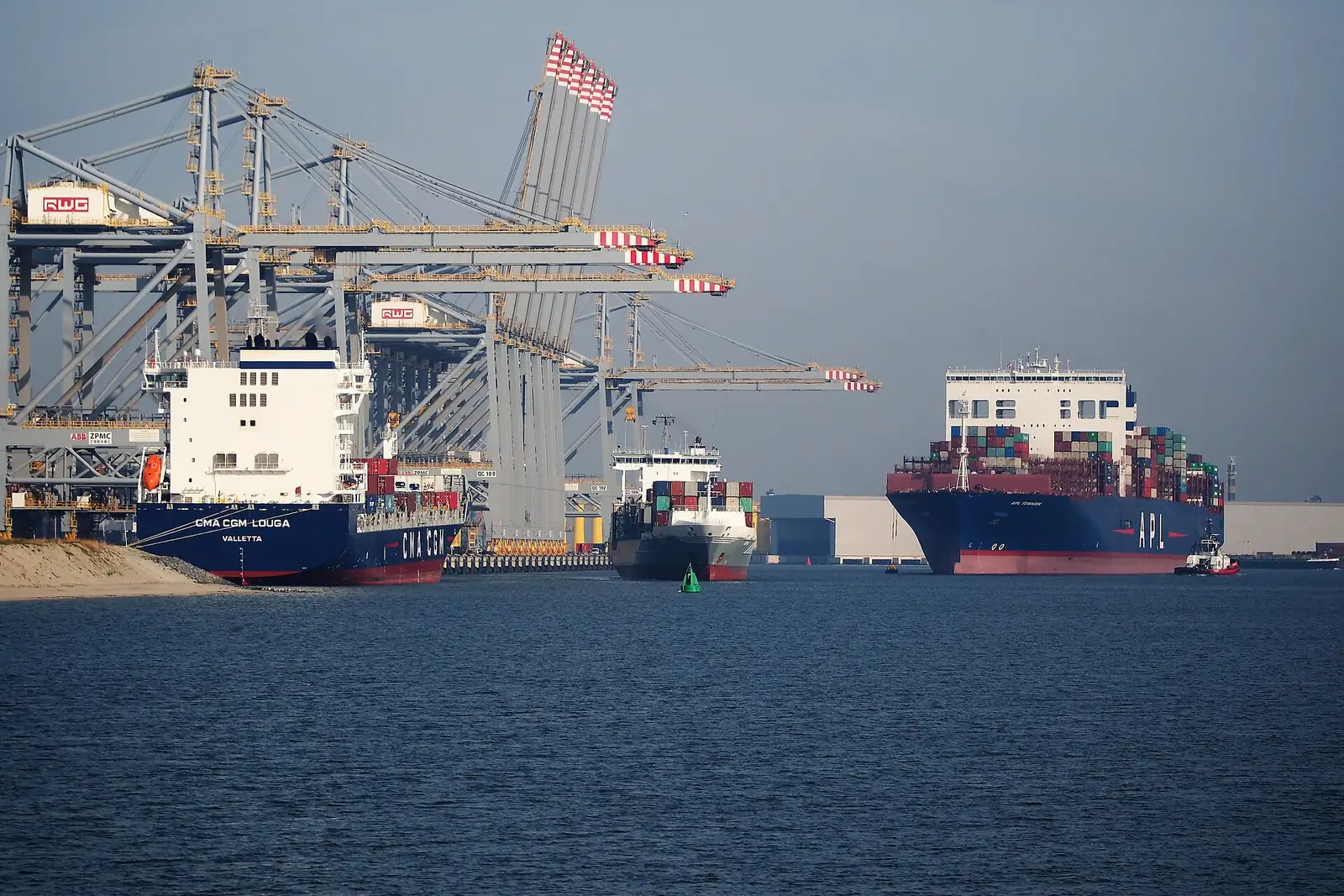
The deep-sea container terminals are on the Maasvlakte, reclaimed land at the mouth of the port, about 40 km west of the city centre. Every terminal below handles deep-sea and feeder vessels and has barge and rail connections, according to the Port of Rotterdam Authority’s terminal map. Your booking confirmation names the terminal and its cut-off times for your sailing.
| Terminal | Area | Address |
|---|---|---|
| Rotterdam World Gateway (RWG) | Maasvlakte II | Amoerweg 50 |
| APM Terminals Maasvlakte II | Maasvlakte II | Europaweg 910 |
| Hutchison Ports ECT Euromax | Maasvlakte I | Maasvlakteweg 951 |
| Hutchison Ports ECT Delta | Maasvlakte I | Europaweg 875 |
| APM Terminals Rotterdam | Maasvlakte I | Coloradoweg 50 |
Source: Port of Rotterdam Authority, “Container terminals and depots in the Rotterdam port area” (map, April 2021 edition). Operators and names change; check the terminal on your booking.
02 City side
Waalhaven and Eemhaven
Closer to the city, around the Waalhaven and Eemhaven basins, are shortsea and barge terminals and many of the empty container depots. Shortsea services within Europe and inland barges often use these terminals rather than the Maasvlakte. A selection from the Port Authority map:
| Operator | Address | Handles |
|---|---|---|
| Rotterdam Short Sea Terminals | Reeweg 35 | Shortsea, barge |
| Matrans Rotterdam Terminal | Streefwaalseweg 15 | Shortsea, barge, depot, rail |
| Barge Center Waalhaven | Waalhaven Westzijde 62 | Shortsea, barge |
| United Waalhaven Terminals | Waalhaven Westzijde 60 and other sites | Depot, barge |
| Kramer City Depot | Reeweg 25 | Depot, barge |
Source: Port of Rotterdam Authority, “Container terminals and depots in the Rotterdam port area” (map, April 2021 edition). Not a complete list.
03 Empties
The empty comes from a depot.
- Release. With the booking, the carrier issues a release reference and names the depot.
- Pick-up. Your haulier collects the empty there. Check its condition; for a reefer, check the unit was inspected (PTI) and set to your booked temperature.
- Load. You stuff and seal the container at your premises.
- Delivery. The full container goes to the deep-sea terminal on the booking, not back to the depot.

04 Inland
Getting the box to the Maasvlakte.
Barge
Inland container barges link Rotterdam with terminals along the Rhine, the Maas and the Dutch and Belgian waterways. Barge calls at the deep-sea terminals are planned through Nextlogic, the port’s planning platform for inland container shipping.
Rail
Every Maasvlakte deep-sea terminal has rail access. The Betuweroute, a dedicated freight railway, connects the port with the German border; the Port Authority is extending rail capacity on the Maasvlakte.
Road
Trucks reach the Maasvlakte via the A15. Since November 2023 the Container Exchange Route, a closed 17 km road network, links terminals, depots, distribution centres and the customs inspection terminal on the Maasvlakte, so containers can move between them without using public roads.
Pre-notification
Whatever the mode, the terminal must know the container is declared for export before it arrives. The export declaration’s MRN is pre-notified to the terminal through Portbase, the port community system.
05 Next
Leave the terminal planning to us. Arrange your shipment from Rotterdam